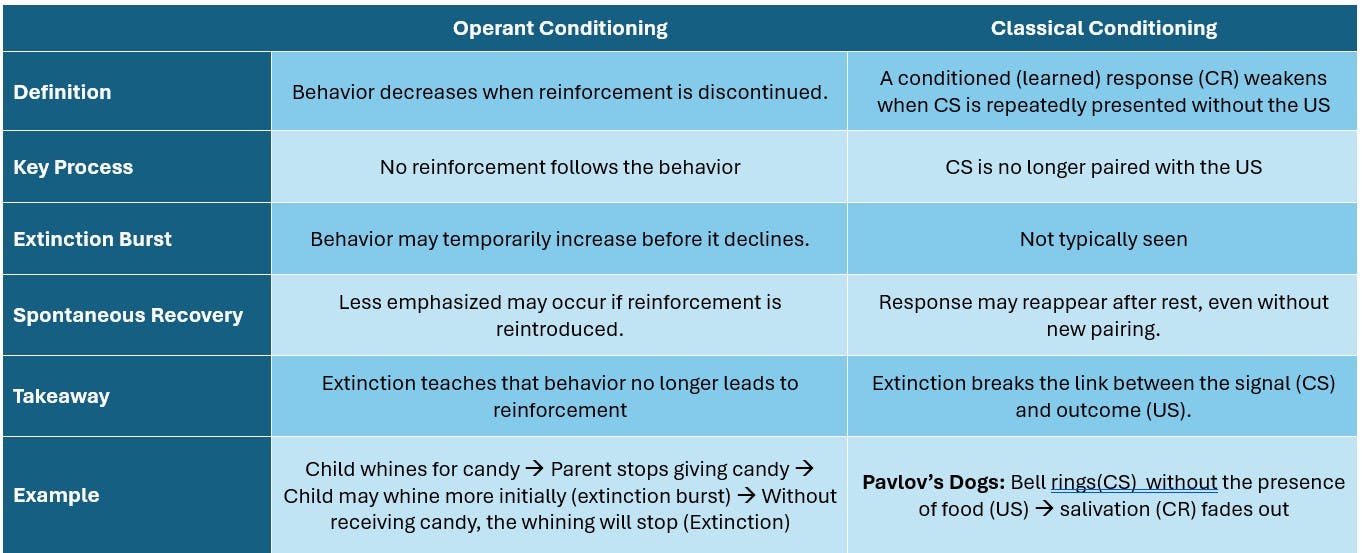
Last week, we posted a practice question on extinction in operant conditioning linked here. Below is a comparison between the process of extinction in both operant and classical conditioning. The EPPP pulls for you to know differences in concepts and so it can be helpful for you to study information in relation to one another, so you know what differentiates one concept from the other. A good way to do that, is to make a table (study tip posted here) or teach the material to someone else where you focus on explaining the concept and highlighting differences (study tip posted here). Check out the post below and table above for more information on Extinction in Operant & Classical Conditioning. Want more information about Learning and Behavior? Check out the post linked here.
🛑 What is Extinction in Operant Conditioning?
In operant conditioning, extinction happens when a behavior that used to be reinforced is no longer followed by reinforcement—so, over time, the behavior decreases or stops.
📌 Example:
Imagine a child who gets candy every time they whine at the grocery store. If the parent stops giving candy, the whining may initially get louder or more frequent (this is called an “extinction burst”). But if the parent consistently withholds candy, the child eventually learns that whining doesn’t work anymore—and the behavior fades out.
🔑 Key Takeaways:
Extinction = Removing reinforcement → behavior weakens.
Expect an extinction burst before the behavior truly declines.
Consistency is essential—reinforcing the behavior “just once” resets the process.
✨ In short: Extinction teaches that the old behavior no longer leads to rewards, so it’s not worth doing.
🛑 What is Extinction in Classical Conditioning?
In classical conditioning, extinction occurs when the conditioned stimulus (CS) is repeatedly presented without the unconditioned stimulus (US). Over time, the learned association weakens and the conditioned response (CR) fades.
📌 Example:
Pavlov’s dogs learned to salivate (CR) when they heard a bell (CS) because the bell was paired with food (US). If the bell keeps ringing but no food follows, the dogs gradually stop salivating—the response becomes extinct.
🔑 Key Takeaways:
Extinction = CS no longer predicts the US → CR decreases.
The learned response isn’t “erased”—it may reappear later (spontaneous recovery).
Relearning happens faster than the initial conditioning.
✨ In short: Extinction in classical conditioning is about breaking the link between a signal and what it predicts.